
Reviewed · GRAND MOSQUE TOURS
Guided Walking Tour of Sultan Qaboos Grand Mosque in Muscat
The first sight is the mosque’s scale: five tall minarets, a 50-meter central dome, broad marble courtyards, and gardens that make Muscat’s main road feel far away. Inside, the 4,000-square-meter hand-woven carpet and huge crystal chandelier give the building real drama, but the guide helps you notice the quieter details.
I like the short one-hour format, which fits neatly into a morning in Muscat, and I like having someone explain the Arabic calligraphy, geometric patterns, and links to Sultan Qaboos’s vision for Oman. The main thing to consider is the strict dress code, since you must bring suitable clothing and a headscarf rather than expect those items to be supplied.
Key points to know before you go
- A $10 cultural tour: The low price makes a guided visit worthwhile, especially if you want context rather than a quick look inside.
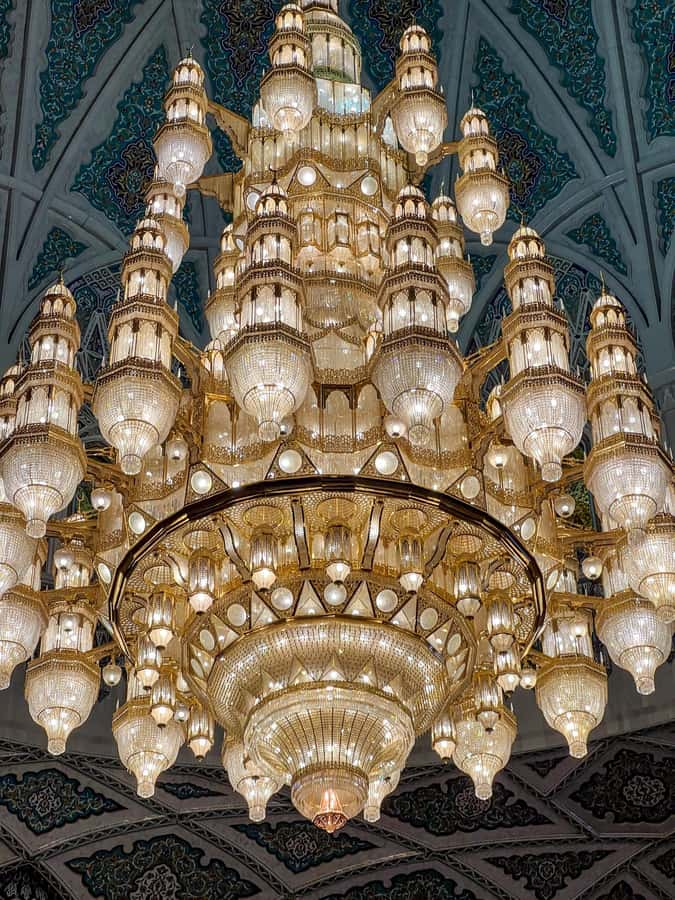
- The main prayer hall is the highlight: See the vast carpet and a 14-meter Swarovski crystal chandelier.
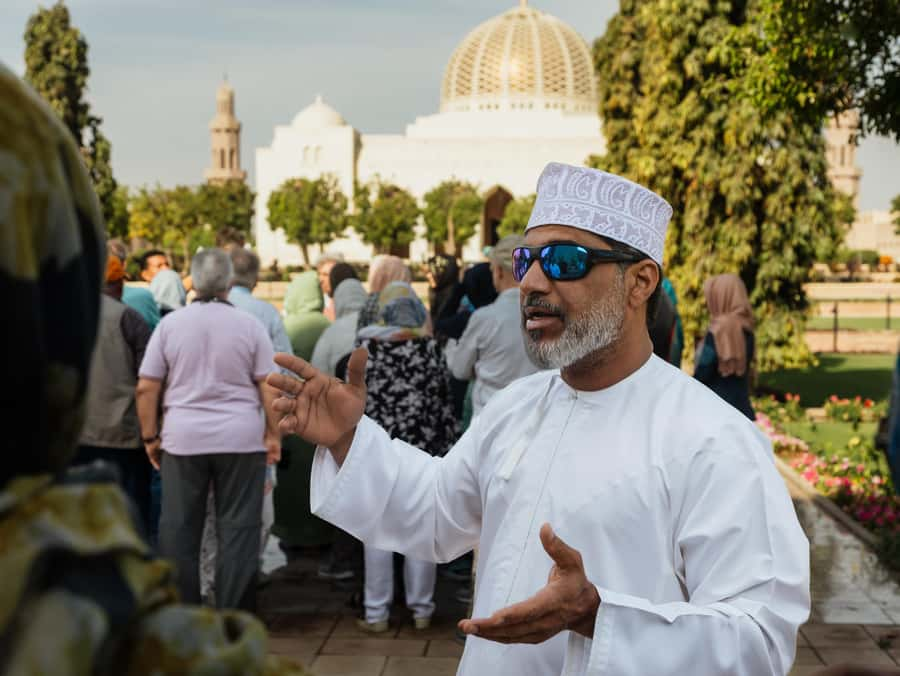
- The tour is conducted in English: Your guide explains Islamic art, Omani design, and the mosque’s place in modern Oman.
- Dress rules matter: Women need long sleeves, long trousers or a long skirt, and a headscarf. Men need long trousers and covered shoulders.
- Meet at the main visitor entrance: Look for the guide holding a GidOman sign, and arrive 10 minutes early.
- Plan for walking: Comfortable shoes will help across the marble courtyards and open-air corridors.
Why the Sultan Qaboos Grand Mosque deserves an hour
Muscat has no shortage of grand buildings, but the Sultan Qaboos Grand Mosque is the city’s clearest architectural statement. It was inaugurated in 2001 to mark the 30th year of Sultan Qaboos bin Said’s reign and was intended as a gift to the nation.
That background gives the building more meaning than its impressive measurements alone. Sultan Qaboos linked the mosque with Oman’s cultural renewal, education, faith, and a spirit of harmony. Your guide brings those ideas into the visit, so you are not left admiring marble without understanding why the complex matters.
I think the tour works best for first-time visitors who want a useful introduction to Islam and Oman without spending half a day in a museum. In one hour, you see the major spaces, hear the main stories, and still have time for another Muscat sight.
The experience has earned a 4.9 rating from 12 reviews, with repeated praise for the clear explanations and the guide’s ability to make small design details meaningful. That is important here. The mosque is beautiful at first glance, but the guided explanation gives your visit more purpose.
More ways to see the Grand Mosque:
- Private Half-Day Tour to Grand Mosque-Nakhal Fort and Hotspring
★ 5.0 · 7 reviews - Private Sultan Qaboos Grand Mosque-Nakhal Fort-Wakan Village – Full Day Tour
★ 5.0 · 6 reviews - Muscat: Private Sightseeing Tour & Sultan Grand Mosque
★ 5.0 · 5 reviews
Meeting at the main visitor entrance
You meet at the main visitor entrance near the central gate facing the main parking area. Look for a guide holding a GidOman sign. Arriving 10 minutes early is sensible, since the mosque grounds are large and you do not want to begin by searching for the correct gate.
Transportation is not included, so you need to arrange your own way to the mosque. This keeps the price down to $10 per person, but it also means you should allow time for the journey and finding the meeting point.
The tour is in English. Group size is not specified, so you should not assume a private tour. Still, the experience can feel personal when numbers are low. One booking had the good fortune of being alone with the guide that morning, which allowed for plenty of questions and close attention.
Wear comfortable footwear. This is a walking tour across courtyards, corridors, prayer halls, and garden areas, not a quick stop beside the entrance.
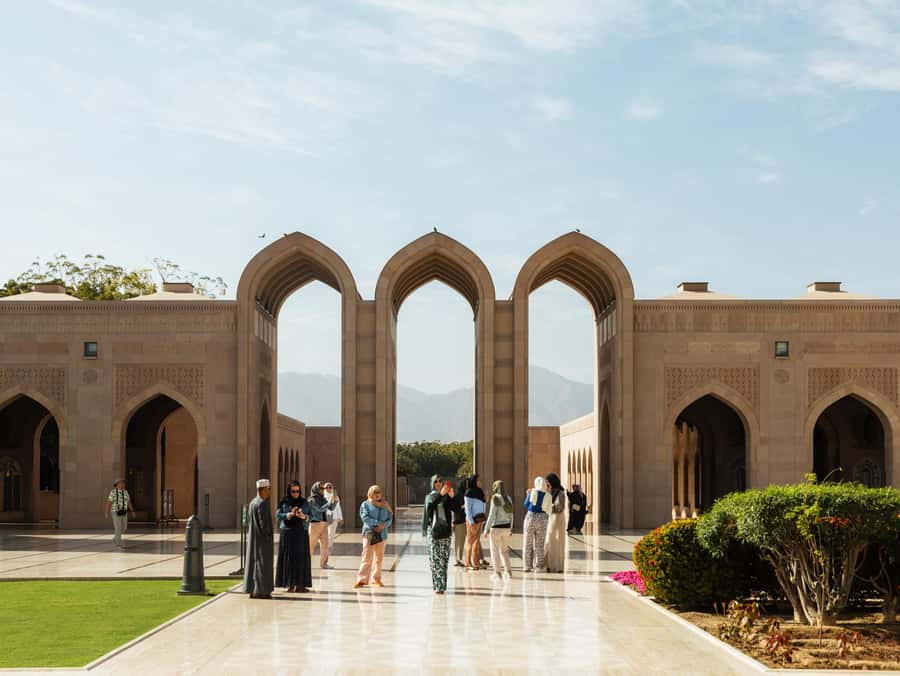
The courtyard, minarets, and first view
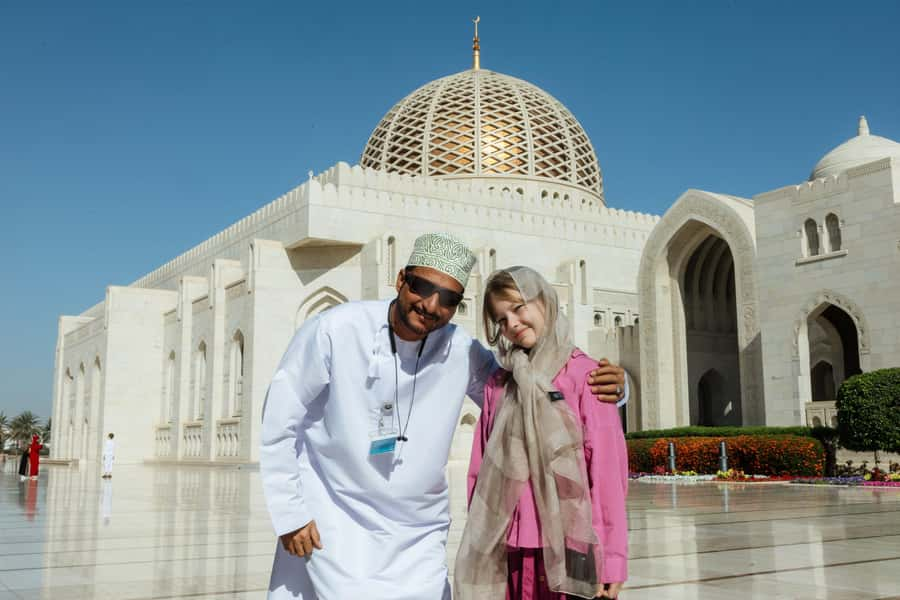
The tour begins with the exterior of the mosque, where the scale becomes clear. Five minarets rise around the complex, with each one connected to the Five Pillars of Islam. Their height and repeated form give the building a strong visual rhythm.
The central dome rises 50 meters above the mosque. From the courtyard, you can take in the ivory and red-brown marble exterior, the archways, polished columns, and carefully kept gardens. The open space also gives you better views than you would get by rushing straight indoors.
I like this opening because it lets you understand the mosque as a complete complex rather than a single decorated room. The gardens soften the stonework, and reflecting pools and shaded greenery provide a calmer setting after the bright streets of Muscat.
Photography is allowed in most areas, but respectful behavior matters. This is an active place of worship, not only a monument. Your guide can help you understand where photographs are suitable and where quiet attention should take priority.
The main prayer hall and its enormous carpet
The main prayer hall is the visual centerpiece. Its floor is covered by a hand-woven carpet measuring more than 4,000 square meters. Six hundred artisans worked on it for four years, and the scale is difficult to grasp until you see how far the pattern extends across the hall.
The carpet is not simply a record-breaking object placed on display. Its repeating designs help create order across a vast prayer space. Your guide points out the patterning and explains how geometric forms and Arabic calligraphy contribute to the room’s sense of balance.
This is where a guided visit earns its modest price. Without explanation, you might notice the carpet’s size and color, take a photograph, and move on. With context, you start looking at the details, the way the pattern directs the eye, and the care required to make such a large work feel unified.
The hall also shows how Omani craftsmanship fits within wider Islamic artistic traditions. The tour explains the use of carved wood, tiled decoration, and formal patterns, while pointing to Persian, Ottoman, and Mughal influences. The result is not a copy of one older style. It is a modern Omani mosque that borrows ideas from across the Islamic world.
More walks around Muscat:
- Muscat: Guided Walking Tour of Corniche, Souq & Mutrah Fort
★ 5.0 · 14 reviews - Old Nizwa authentic walks
★ 5.0 · 21 reviews - Balcony Walk of Jebal Shams (Highest Peak of Oman)
★ 5.0 · 12 reviews - Nizwa: Jebel Shams Balcony Walk and Via Ferrata Adventure
★ 4.8 · 12 reviews
The crystal chandelier overhead
Look up and the carpet’s visual weight is balanced by the central chandelier. It measures 14 meters and is decorated with hundreds of thousands of Swarovski crystals. The light catches the crystals above the prayer hall, adding sparkle without taking attention entirely away from the architecture.
The chandelier is one of the easiest details to appreciate without a guide, but its scale becomes more striking when you compare it with the surrounding room. It is not a small ornament hanging in a compact interior. It is built for a monumental hall and helps fill the vertical space beneath the dome.
I would give yourself time to look upward here. The room contains enough decoration to make hurried photography feel almost pointless. Pause, take in the chandelier, then notice how the ceiling, walls, carpet, and calligraphy relate to one another.
The tour’s strongest praise centers on this mix of visual beauty and explanation. The building provides the spectacle, but the guide helps you see why individual elements were chosen and how they work together.
Calligraphy, tilework, and the meaning in small details
Arabic calligraphy and colorful mosaic tilework appear across the walls and domed ceiling. The guide explains the Quranic verses and geometric designs, helping you understand that the decoration is not random filler.
This is especially useful if you do not read Arabic or have little background in Islamic art. You can still appreciate the shapes and colors, but an English explanation gives the writing and patterns a clearer role. Instead of seeing decoration as something merely pretty, you begin to notice how it supports ideas of order, devotion, and harmony.
The carved teakwood details add another layer. Wood brings warmth to a complex dominated by marble and stone, while the doors and screens show the level of care given to functional parts of the building.
The tour does not require specialist knowledge from you. It is designed as a short, accessible introduction, and the guide can answer questions as you walk. That makes it a good match for first-time visitors, families with an interest in culture, and anyone who wants more than a silent circuit through the building.
The women’s prayer hall and quieter spaces
You also visit the women’s prayer hall. It is more intimate than the main prayer hall but remains carefully decorated, with carved wooden doors and delicate lighting.
This stop matters because it shows that the mosque’s design is not limited to one grand room. The smaller space has its own character and offers a useful comparison. You can see how the same attention to materials and detail works at a more human scale.
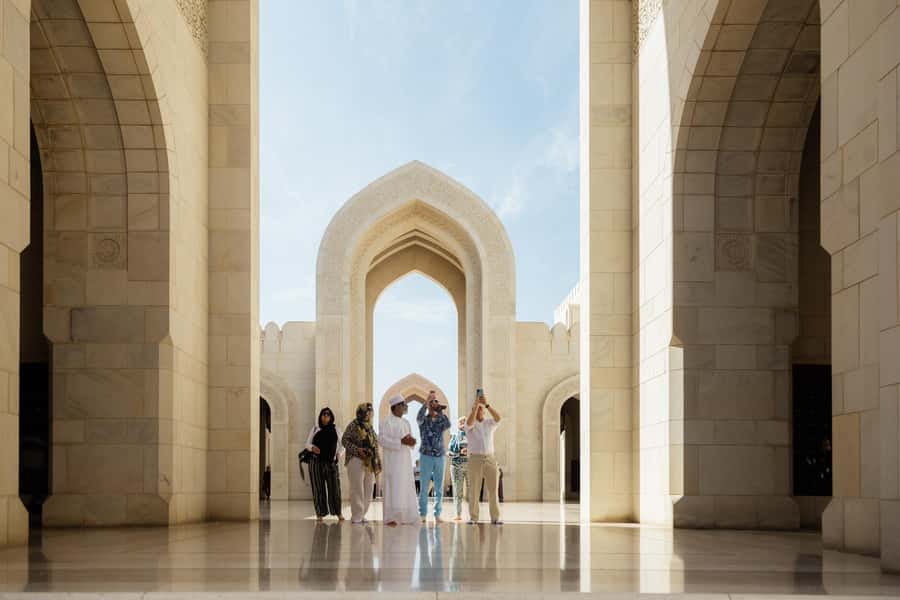
The tour then continues through open-air corridors lined with polished sandstone columns. Informative displays add context as you go, while views open toward the gardens. These passages give you a break from the main hall’s scale and let you notice the building’s practical movement between indoor and outdoor spaces.
I appreciate this part of the route because it prevents the visit from becoming a single photo stop. You see how the complex is organized, how its courtyards connect, and how the gardens frame the prayer halls.
Gardens, courtyards, and the best photo opportunities
The gardens surround the mosque with cooling greenery, reflecting pools, and carefully arranged paths. They also provide some of the best angles for photographing the exterior, especially the contrast between the pale marble, red-brown stone, arches, and minarets.
The grounds are kept in formal order, so expect polished courtyards rather than a wild garden. That neatness suits the building. Greenery gives the eye somewhere to rest, while the water and open space help reduce the visual weight of the stone.
Muscat’s heat is worth considering. The route includes open courtyards and corridors, and the tour lasts one hour, so wear light, modest clothing and bring water. A bottle is included, but sensible clothing will do more for your comfort than relying on a drink alone.
Photography is permitted in most areas, but you should keep the religious setting in mind. Take pictures when appropriate, avoid treating worshippers as subjects, and follow your guide’s instructions.
What your $10 pays for
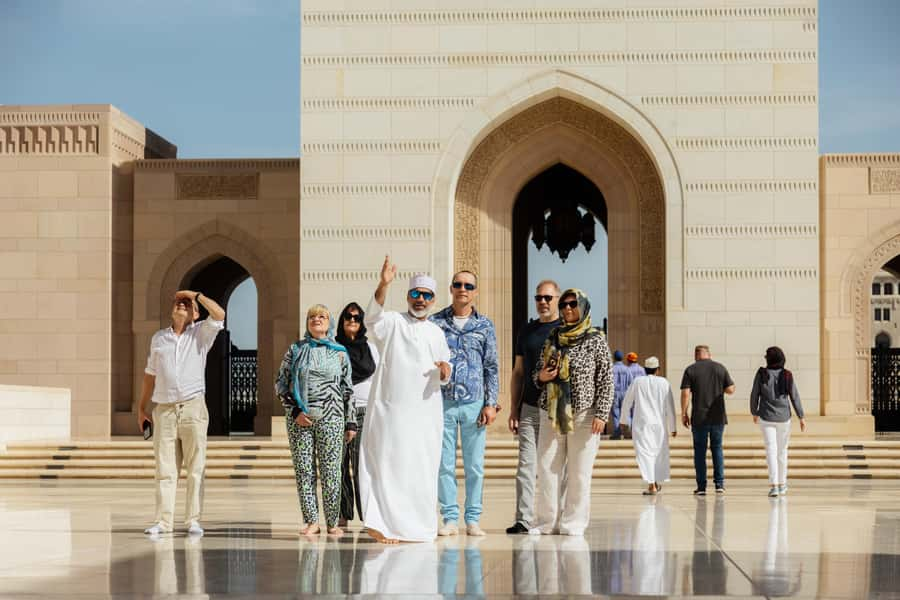
At $10 per person, this is one of the easier Muscat experiences to justify. You receive a guided tour, bottled water, and an hour of explanation inside one of Oman’s most important buildings.
The value is not in the length. One hour is short, and you will not examine every corner of the complex. The value is in the interpretation. A guide can point out the meaning of the calligraphy, explain the mosque’s connection with Sultan Qaboos, and help you understand the mixture of Omani, Persian, Ottoman, and Mughal design.
You are paying for access to a clearer story, not for transportation or special clothing. Since neither transport nor a headscarf is included, budget a little extra effort before you arrive. If you are already in Muscat and can reach the mosque easily, the price is particularly attractive.
The short format also suits a busy itinerary. You can pair it with other Muscat sightseeing rather than building your whole day around the mosque. If you prefer slow photography or long periods of quiet observation, one hour may feel tight.
Dress rules and practical preparation
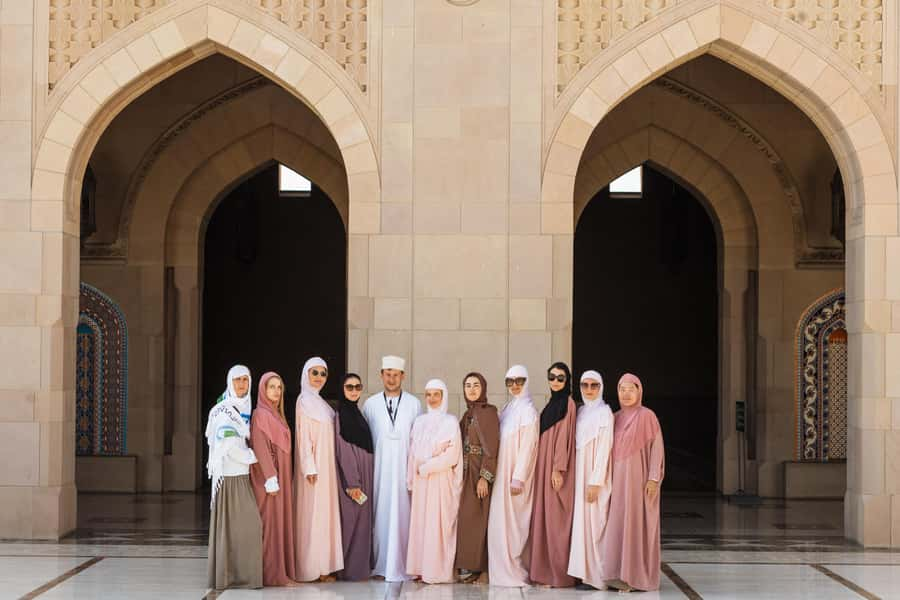
Modest dress is required. Women need long sleeves, long trousers or a long skirt, and a headscarf. Men need long trousers and covered shoulders.
Bring your own headscarf and suitable clothes. The tour does not provide them, so do not leave this until the last minute. Clothing that works for the mosque will also be useful for other cultural sites in Oman.
Arrive 10 minutes early at the main visitor entrance. Wear comfortable shoes, since you will walk through the courtyards and corridors. Photography is allowed in most areas, but respect for the religious setting should guide how and when you use your camera.
The activity offers free cancellation up to 24 hours before the start time, and you can reserve now and pay later. Those options help if your Muscat schedule is still changing, though the practical details of getting to the mosque remain your responsibility.
Who should book this walking tour
I would choose this tour if you are visiting Muscat for the first time, have an interest in Islamic art, or want a short cultural activity with clear structure. It is also a good choice if you like asking questions, since the guide adds value by explaining details that are easy to miss.
The tour suits people who appreciate architecture but do not want a long academic lecture. The main sights are impressive on their own, and the explanations stay tied to what you can see: the carpet, chandelier, calligraphy, tilework, doors, columns, and gardens.
I would think twice if you cannot meet the dress requirements or if you want a relaxed visit with no fixed pace. The hour goes quickly, and a guided walk naturally gives you less freedom than exploring alone. Transportation is also not included, which matters if you are staying far from the mosque.
Should you book the Sultan Qaboos Grand Mosque tour?
Yes, I would book it if the $10 price fits your plans and you can arrive in appropriate clothing. The main prayer hall alone is worth seeing, but the guide turns a beautiful building into a more understandable one.
You will get the most from it by arriving early, dressing correctly, wearing comfortable shoes, and saving a few minutes for the gardens and exterior photographs. If you already know a great deal about Islamic architecture, the tour may feel basic, but its short length and low cost still make it an easy addition to a Muscat day.
FAQ
How long does the Sultan Qaboos Grand Mosque tour last?
The guided walking tour lasts one hour.
How much does the tour cost?
The price is $10 per person.
Is the tour conducted in English?
Yes. The experience includes a live English-speaking guide.
Where do I meet the guide?
Meet at the main visitor entrance near the central gate facing the main parking area. Look for a guide holding a GidOman sign.
What should women wear?
Women must wear long sleeves, long trousers or a long skirt, and bring a headscarf.
What should men wear?
Men must wear long trousers and cover their shoulders.
Is transportation included?
No. You need to arrange your own transportation to and from the Sultan Qaboos Grand Mosque.
Just added around Muscat
- Try scuba Diving Tours To Daymaniyat Islands.★ 5.0 · 12 reviews
- Private Muscat City Sightseeing Tour – A Fascinating Capital★ 4.5 · 12 reviews
- Muscat by Night with Local Dinner from Muscat★ 3.5 · 6 reviews
- Muscat Private Departure Airport Transfer★ 5.0 · 4 reviews
- Muscat Private Arrival Airport Transfer★ 4.0 · 7 reviews
- Muscat Shore Excursion: Private City Highlights Tour★ 4.5 · 15 reviews
- Muscat : Luxury car with private driver★ 5.0 · 18 reviews
- 5 Hours Private Tour in Muscat City★ 5.0 · 3 reviews
Grand Mosque Tours, compared.
Private Half-Day Tour to Grand Mosque-Nakhal Fort and Hotspring
Read our review →
Private Sultan Qaboos Grand Mosque-Nakhal Fort-Wakan Village – Full Day Tour
Read our review →

Browse the lists this tour appears in