
Reviewed · MUSCAT TOURS
5-Days Private Oman Tour from Muscat
Oman packs an astonishing range of scenery into five days: a turquoise canyon pool, a sand desert, high mountain villages, ancient tombs, and great stone forts. This private tour links them in one long loop from Muscat, with an Omani guide at the wheel and a four-wheel-drive vehicle for the rougher roads.
I like the excellent mix of nature and culture, especially the chance to swim at Wadi Shab and watch the sunset in Wahiba Sands. I also like the practical value: four hotel nights, four breakfasts, four dinners, water, entry fees, and Muscat pickup are included. The main drawback is the pace. You cover a lot of ground, and Wadi Shab, Jebel Akhdar, and Jebel Shams all require walking or time outdoors.
Key points to know before booking

- Wadi Shab is the active highlight: Allow four hours for the hike, pools, and cave swim.
- Wahiba Sands adds a full desert night: You can watch sunset from the dunes and rise early for sunrise.
- The route covers Oman’s major regions: Coast, wadis, desert, mountain villages, and historic towns all appear.
- Your private guide matters: Guides including Khalfan, Qambar, Yahya al Jabri, and Hussein al Hamdani have received especially warm praise for their driving, patience, and local knowledge.
- Meals are only partly covered: Four breakfasts and four dinners are included, but lunch is not.
- The schedule favors breadth over leisure: You see a great deal, but this is not a slow village-and-beach holiday.
A big Oman loop in five demanding days

At $1,655.10 per person, this is not a budget excursion. The value comes from what is bundled into the price: private transport, an English-speaking Omani guide, four-wheel drive, four nights of accommodation, eight included hotel meals, bottled water, and several admission fees.
You are also paying for the route itself. Reaching Wadi Shab, Wahiba Sands, the interior mountain towns, and Jebel Shams independently would take careful planning, separate transport, and a good sense of changing road conditions. A private trip lets you ask questions, adjust the rhythm when possible, and avoid sharing the vehicle with a large group.
The tour begins at 8:30 a.m. with pickup from a hotel, port, or airport in the Muscat area. The exact hotels are not named in the information provided, so ask where each night will be spent before you confirm. Room arrangements are listed as a standard double for two people, a double room with an extra bed for three, or two double rooms for four.
More Private Tours in Muscat
- Half-Day Private Muscat City Tour – Top Landmarks in Just 4 Hours
★ 5.0 · 256 reviews - Oman: Private Muscat City Tour With Pick-up/ Drop-off
★ 4.4 · 234 reviews - Muscat : 4 hours private Tour of Muscat City with Pick-up
★ 4.5 · 163 reviews
Day 1: Bimmah Sinkhole, Wadi Shab, and the turtle coast
The first day heads southeast from Muscat toward the coast. Bimmah Sinkhole is a short photo stop rather than a major visit, with about an hour allowed. It gives you a striking first look at Oman’s pale rock and clear water, but do not expect a long swim session here. The main event is still ahead.
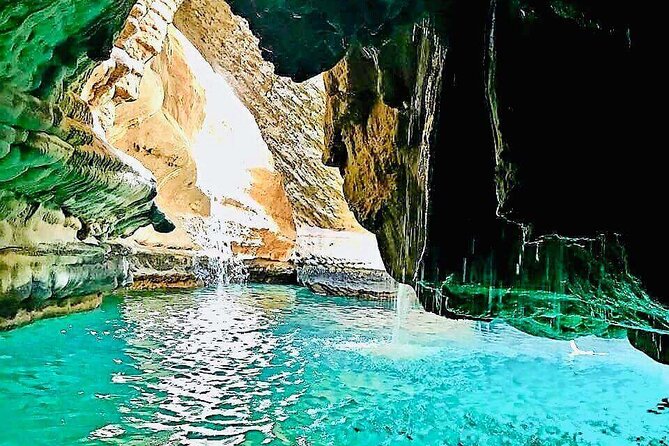
Wadi Shab takes about four hours, and that timing matters. You hike for roughly 35 minutes through a canyon lined with palms and shaped by water flowing down from the mountains. The route leads to a series of clear pools where you can swim from one to the next.
The final pool is the memorable part. An opening between the rocks leads into a narrow cave, where sunlight reaches the turquoise water and a small waterfall falls inside. You need to be comfortable walking over uneven ground and swimming. Pack swimwear, secure footwear, and a way to protect valuables from water.
A boat transfer is included for Wadi Shab, along with the admission fee. Still, this is not a gentle sightseeing stop. The hike, heat, rocks, and swimming make it one of the more physical parts of the trip. If you prefer to stay dry or have limited mobility, ask your guide how much of the wadi you can comfortably visit.
Wadi Tiwi follows as a 45-minute photo stop. It has a greener feel, with plantations around the village and a more settled agricultural character. I like the contrast: Wadi Shab feels dramatic and canyon-like, while Tiwi shows how people use water and fertile ground in an otherwise dry country.
The day ends at Ras Al Jinz Turtle Reserve. The scheduled visit lasts about two hours, and turtle-watching entry is included. The timing and wildlife sightings can depend on conditions, so treat this as a chance to see the reserve rather than a guarantee of a close encounter. This is also a long first day, so the included dinner is welcome.
Day 2: Sur’s boats, Wadi Bani Khalid, and a night in the dunes
Sur gives the second day a strong maritime theme. The city has long connections to Oman’s seafaring past, and the dhow factory lets you see traditional wooden boats being built. The visit lasts about 45 minutes, with entry included.
You also get a look at old fortifications in Sur, including the city’s traditional defensive character. This is a compact stop, but it adds useful context before the route turns inland. Oman’s coastal wealth was tied to sailing, trade, and boatbuilding, and the dhow workshop makes that past easier to picture.
The route continues to Al Kamil Wal Wafi and an Omani ghazal farm. The stop lasts about 30 minutes. It is a small, unusual break from the usual forts and viewpoints, allowing you to see the gazelles associated with the farm.
Wadi Bani Khalid is the day’s main natural stop. A short walk leads to large emerald pools surrounded by rock. You can swim, sit in the sun, relax, or have a picnic in the wadi. Unlike Wadi Shab, the appeal here is less about reaching a cave and more about enjoying open pools at a calmer pace.
The water and scenery make this a good place to slow down, but lunch is not included anywhere on the tour. You need to plan for that daily expense, and you may want to carry snacks even though bottled water is provided. The four included dinners and breakfasts help, but lunch remains your responsibility.
By late afternoon, you reach Wahiba Sands. Your camp provides a change of setting that feels almost theatrical after the wadis and coast. You can relax or take part in a 4WD drive over the dunes, then watch the sun drop from a high ridge of sand.
Dinner at camp and time around a fire are included. The accommodation is a standard camp arrangement, but the precise camp name and facilities are not supplied, so ask about bedding and bathroom arrangements if those details matter to you. This is also one of the most romantic parts of the route, especially for couples.
Day 3: Sunrise, Bronze Age tombs, and Oman’s high country
Day three starts early with sunrise from the Wahiba dunes, followed by breakfast. The sunrise stop lasts about 30 minutes, so expect a quick outing rather than a long desert walk. Bring a warm layer if you are sensitive to cool morning air, though the tour information does not specify seasonal temperatures.
The drive then turns toward the interior and the Zukait Tombs near Izki. These beehive-shaped Bronze Age tombs form part of a protected archaeological setting. The stop lasts about an hour and gives you a look at an older Oman, far removed from the modern coastal cities.
The tombs are valuable because they are not simply another scenic viewpoint. They show how much of Oman’s story reaches back into the Bronze Age, and their simple stone forms are set against open mountain country. Visitor interpretation may be limited, so your guide’s explanation can make a big difference here.
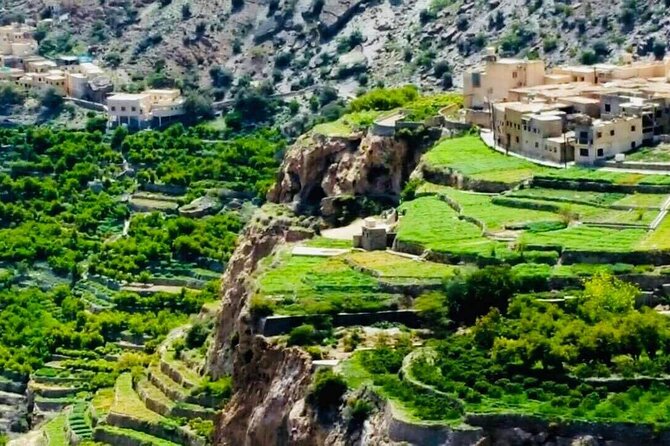
Jebel Akhdar, or the Green Mountain, is next. The mountain area rises to about 2,980 meters, with the Saiq Plateau around 2,000 meters above sea level. The two-hour stop brings cooler high-country scenery and a sharp change from the desert below.
The name suggests greenery, but do not picture a forested mountain. The appeal lies in the high elevation, terraces, villages, and mountain air. Roads and access can be more demanding in this part of Oman, which is one reason the 4WD and experienced local driver are useful.
Birkat Al Mouz follows for about 30 minutes. The village is known for banana plantations and its position against the mountains. Its name means Banana Pool, a reminder that Oman’s traditional settlements depend on carefully managed water rather than rainfall alone.
That idea becomes clearer at the nearby aflaj irrigation systems. These channels are among Oman’s UNESCO-listed irrigation systems and remain an important example of old water management. The visit is brief, but it adds meaning to the plantations, palms, and villages you have been seeing.
The day also brings you to Nizwa, one of Oman’s key historic cities. Because this schedule includes several stops, do not expect long, unplanned hours in town. The benefit is variety, while the cost is limited time at each place.
A few more Muscat half-days worth weighing up
- Half-Day Private Muscat City Tour- with a local guide
★ 5.0 · 143 reviews - Half Day Muscat City Tours Private
★ 5.0 · 127 reviews - Muscat: Private City Guided Tour
★ 5.0 · 91 reviews - Oman: Private City Tour of Muscat with pick up/drop off
★ 4.4 · 88 reviews
Day 4: Nizwa’s fort, old villages, and the high canyon
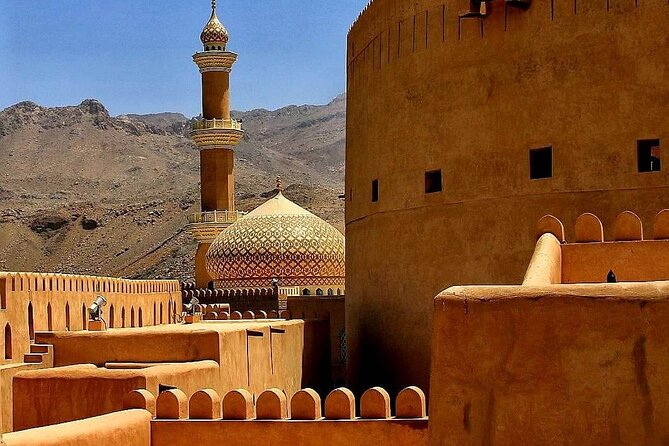
Nizwa Fort is one of the route’s major cultural stops. Built in the seventeenth century, it is known for its massive form and defensive design. You have about 45 minutes inside, and admission is included.
The fort helps explain how power worked in inland Oman. Towers, thick walls, and interior rooms show a practical approach to defense and daily life. Forty-five minutes is enough for a focused visit, though a history enthusiast may wish for more time.
Nizwa Souq gives you a different view of the city. The market is divided into areas for produce, meat, fish, silverwork, and handmade goods. You have about an hour to browse and shop.
This is a good place to look for Omani silver craft and local objects, but keep the schedule in mind. Since the tour is private, you can ask your guide how to use your hour, whether you want shopping or a quick look at the market’s separate sections.
Al Hamra offers another layer of old Oman. The town is around 400 years old, with an abandoned village nearby that is estimated to be 700 to 1,000 years old. The stop lasts about 45 minutes, so you will get an impression of the ruins rather than a long archaeological visit.
Misfah al Abriyyin, a mountain village about 1,000 meters above sea level, follows. Its terraces and traditional setting make it one of the more atmospheric stops on the route. Wear shoes with a good grip, since village paths can be uneven, and do not expect a flat, paved walk.
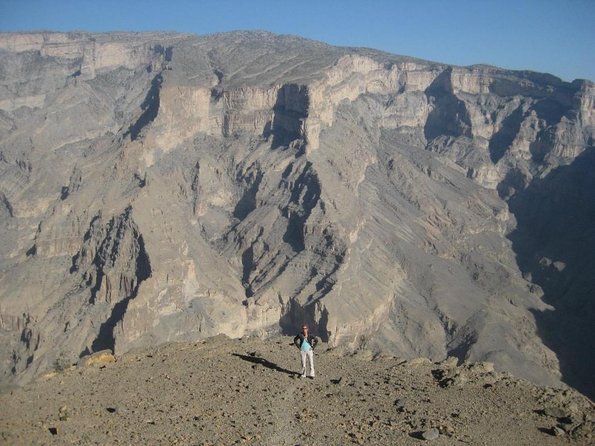
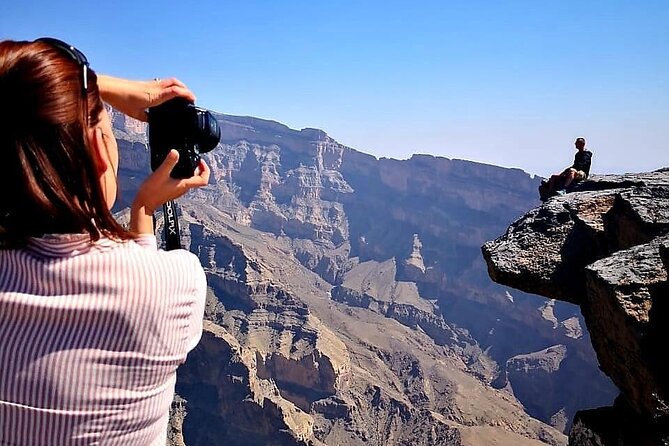
Jebel Shams is the final major stop of the day. It is the highest mountain in Oman and the highest point in the Hajar range. The hour here is aimed at views and the scale of the mountains, not a full hike.
The area is often linked with the first sunrise in Oman because of its height. After a packed day of forts, markets, villages, and mountain roads, the open views provide a fitting close. This is another day when the schedule rewards early starts and reasonable fitness.
Day 5: Wadi Ghul, a living museum, and two great forts
The final day begins near Wadi Ghul, often called Oman’s Grand Canyon. The abandoned village and the deep canyon setting provide one of the tour’s strongest viewpoints. The stop lasts about 45 minutes, enough to see the setting and take photos, but not enough for a serious canyon hike.
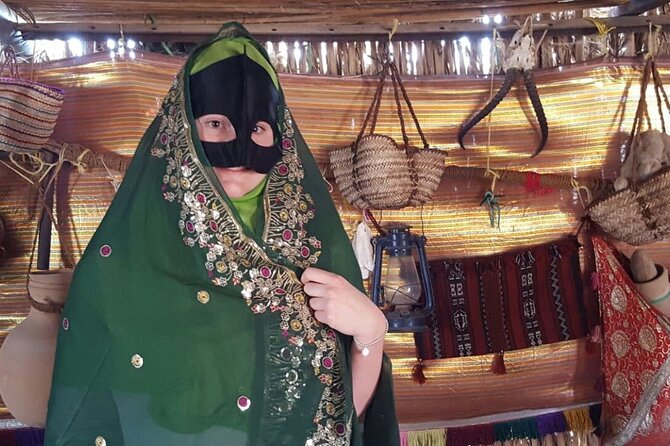
Bait Al Safah in Al Hamra gives the day a more human focus. This living museum is housed in an old Omani home and presents elements of traditional daily life. The visit lasts about 45 minutes, and entry is included.
I like the pairing of Wadi Ghul and Bait Al Safah. One shows the force of the mountains, while the other shows how people adapted to them through old homes, food traditions, tools, and household routines. The information supplied does not detail every demonstration, so ask your guide what is operating on your date.
Bahla Fort is next. It is the only fort in Oman listed by UNESCO, and it underwent major restoration before reopening in 2012. You have about an hour, with admission included.
One practical point: visitor information at Bahla is limited. Your guide’s explanation is especially useful here because the walls and rooms do not always explain themselves. The fort’s scale and age are impressive, but allow time to simply walk and look rather than expecting a highly signposted museum.
Jibreen Castle closes the tour. Built in 1675, it is well preserved and known for two towers, painted ceilings, and rooms that can be explored with an audio tour. The scheduled visit is one hour, and entry is included.
Jibreen is a strong final stop because it feels more intimate than a giant fortress. Its rooms give you a clearer sense of palace life, scholarship, and defense, while the painted ceilings add detail after several days of bare stone walls and mountain views.
Guides, transport, and the pace of the road
The private format is one of the best reasons to choose this trip. You are not assigned to a large group, and only your party takes part. That can make photo stops, questions, and short changes in pace easier.
The English-speaking Omani guide is central to the experience. Specific guides praised in the available feedback include Khalfan, Qambar, Yahya al Jabri, and Hussein Al Hamdani. Khalfan was singled out for excellent driving and for going out of his way to help, while Yahya and Hussein were described as friendly, professional, and well informed. Your assigned guide may be different, so do not treat those names as a guarantee.
A comfortable 4WD is included. That matters for Wahiba Sands and the mountain areas, where a regular city car would be less suitable. Bottled water is also included, a small but useful comfort in Oman’s heat.
The route is busy. You will spend substantial time on the road, often moving between stops that are separated by long distances. I would choose this trip if you want to see many parts of Oman in one visit, not if you want lazy mornings or several nights in one place.
What the $1,655.10 price really covers
The price is easiest to judge as a private package rather than a sightseeing ticket. You are paying for a driver-guide, a private 4WD, accommodation, breakfasts, dinners, water, pickup and drop-off, and entry to Wadi Shab, the dhow factory, Ras Al Jinz turtle watching, Nizwa Fort, Bahla Fort, Bait Al Safah, and Jibreen Castle.
Lunches are not included, and that is the main regular extra to budget for. Group discounts may be available, which could improve the per-person value for a small party.
The booking pattern suggests that people often arrange this trip well ahead, with an average booking point of about 50 days before departure. I would plan early if your dates are fixed, particularly if you want a certain room setup or a specific guide.
Cancellation is generous if you act early: cancel at least six full days before the start for a full refund. Cancel two to six days ahead and the stated refund is 50 percent. Less than two days means no refund, and poor weather can lead to a new date or full refund.
Who should book this private Oman tour?
I would recommend it to first-time visitors who want Oman’s major natural and historic sights without arranging several hotels, drivers, and admission tickets themselves. It suits couples, families, and small groups who value privacy and want an English-speaking Omani guide.
It is also a good fit if you want variety. In five days, you see the sea, wadis, desert, mountain villages, archaeological sites, markets, museums, and forts. Few short Oman trips offer such a broad range.
I would hesitate if you dislike early mornings, long drives, uneven walking, swimming, or heat. Wadi Shab is physical, the desert begins early, and the mountain days involve repeated changes in elevation and terrain.
Should you book it?
Book this tour if your main goal is to experience many sides of Oman in a single, organized journey. The strongest reasons are the private 4WD, local guide, included dinners and accommodation, and the route’s excellent range from Wadi Shab to Wahiba Sands and Jebel Shams.
Before paying, confirm the hotel names, desert camp facilities, daily lunch plan, and whether a particular guide is available. If you want a slower trip, ask about removing a stop or adding a night. If you want an efficient first look at Oman, this is a well-packed and worthwhile choice.
FAQ
How long is the Oman tour?
The tour lasts approximately five days and includes four nights of accommodation.
Where does the tour begin and end?
Pickup and drop-off are offered at hotels, ports, and airports in the Muscat area.
What time does the tour start?
The stated start time is 8:30 a.m.
Is this a private tour?
Yes. Only your group participates, and the tour uses a private 4WD vehicle.
Is an English-speaking guide included?
Yes. An English-speaking Omani tour guide is included.
Which meals are included?
Four breakfasts and four dinners are included. Lunch is not included.
Is accommodation included?
Yes. Standard room arrangements are included for two, three, or four people, depending on group size.
Are attraction entry fees included?
Entry is included for turtle watching, the dhow factory, the Wadi Shab boat, Nizwa Fort, Bahla Fort, Bait Al Safah Museum, and Jibreen Castle.
Can I cancel the tour for a full refund?
You can receive a full refund if you cancel at least six full days before the experience start time. Different refund rules apply for cancellations made closer to departure.
Just added around Muscat
- Try scuba Diving Tours To Daymaniyat Islands.★ 5.0 · 12 reviews
- Private Muscat City Sightseeing Tour – A Fascinating Capital★ 4.5 · 12 reviews
- Muscat by Night with Local Dinner from Muscat★ 3.5 · 6 reviews
- Muscat Private Departure Airport Transfer★ 5.0 · 4 reviews
- Muscat Private Arrival Airport Transfer★ 4.0 · 7 reviews
- Muscat Shore Excursion: Private City Highlights Tour★ 4.5 · 15 reviews
- Muscat : Luxury car with private driver★ 5.0 · 18 reviews
- 5 Hours Private Tour in Muscat City★ 5.0 · 3 reviews
Muscat Tours, compared.
Daymaniat Islands Snorkeling Trip with Brunch
Read our review →
Half-Day Sightseeing Essentials Tour and Audio Guide
Read our review →
Daymaniat Islands Snorkeling Tour with Refreshments
Read our review →

Daymaniyat Islands Snorkeling Trip with BBQ Lunch
Read our review →
Snorkeling at Dimaniyat Islands and Dolphin Watching
Read our review →Browse the lists this tour appears in